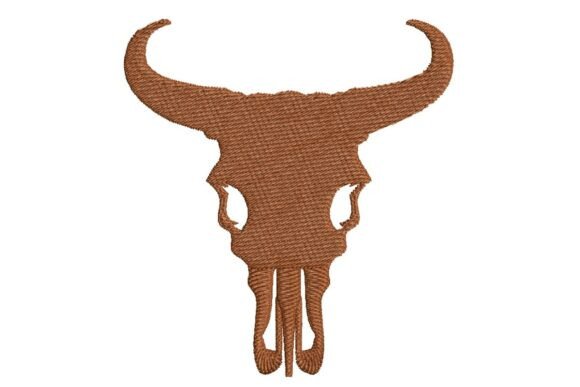
Western Bison Skull Embroidery Design
A Craft Fair Designer’s Real-World Review Before Booth Day
As an embroidery designer who’s stitched through 17 craft fairs, three holiday markets, and countless Etsy restocks, I approach every new machine embroidery design like a product scout—not just for beauty, but for booth survival. When I first read “Western Bison Skull Embroidery Design”—a solid, textured brown silhouette of a bison or bull skull with prominent curved horns—I felt immediate recognition: this isn’t whimsical or delicate. It’s rugged, rustic, and quietly confident. It leans into Western heritage without cliché, nods to North America’s open landscapes, and carries the kind of grounded presence that stops shoppers mid-aisle.
Where This Design Truly Shines on Handmade Products
The Western Bison Skull Embroidery Design is a natural fit for products where authenticity and tactile strength matter. On a heavyweight canvas tote bag? Yes—bold, legible, and instantly memorable at arm’s length. On a denim apron? It grounds the whole piece, giving kitchen or workshop wear a signature artisanal edge. For tea towel embroidery, it holds up beautifully—especially when placed high on the towel’s front panel, where the skull’s clean silhouette reads clearly against the fabric texture.
It also excels as an embroidered patch—stitched onto leather jackets, canvas market bags, or even woven into small fabric pouches for gift sets. As a pillow cover motif? Absolutely. Its strong outline and balanced negative space translate well across scale, and the textured brown thread adds dimension without visual noise. For caps, I’d recommend placing it centered on the front panel—but only on structured, medium-crown hats with smooth crown fabric; avoid low-profile curved surfaces unless you’ve tested hoop clearance and stitch pull.
What Makes It Sell—And What Requires Extra Care
This design works because it’s immediately legible. No decoding needed. At a craft fair, where attention spans are measured in seconds, that matters more than intricate fill work. Customers recognize the symbol—bison, resilience, frontier spirit—before they even read your booth sign. That emotional shorthand boosts buyer engagement, especially among shoppers drawn to handmade product with regional pride or earthy aesthetics.
But here’s where experience kicks in: texture is everything. The description says “textured brown,” which implies varied stitch density—not flat satin fill. That’s great for depth, but risky on highly napped fabrics (like terry cloth towels) or dark garments where subtle tonal shifts disappear. Always test the Western Bison Skull Embroidery Design on scrap fabric matching your final product: same weight, same weave, same dye lot. Check thread contrast under both indoor and natural light—brown-on-brown can vanish if stabilizer or fabric undertones mute the tone.
Also note: those curved horns demand clean curve stitching. If your embroidery file includes tight inner corners or dense satin borders, inspect them closely at 200% zoom. Tiny details often blur or pucker during commercial embroidery—especially on stretchy or loosely woven cottons. And while it scales well as a focal design (4–5 inches wide), don’t shrink it below 2.5 inches without verifying clarity. Small lettering isn’t an issue here—but fine horn tips or narrow eye sockets might lose definition.
Production Practicality for Small Shops & Digital Sellers
For Etsy sellers and digital embroidery file shops, the Western Bison Skull Embroidery Design is a smart catalog addition. It photographs cleanly—no glare-prone metallics, no gradient confusion—and pairs effortlessly with printable mockups for listings. Use neutral backdrops and natural lighting to highlight its organic weight and texture. In your product gallery, show it on three contrasting items: a natural linen tote, a black denim cap, and a cream tea towel. That signals versatility without overpromising.
Batch production? Very doable. With moderate stitch density and no tiny isolated elements, it runs consistently across machines—assuming proper stabilizer choice. For tea towel embroidery, use tear-away plus light cut-away for stability. For caps, switch to cap-specific foam + cut-away. And always confirm hoop size compatibility before loading dozens of files—some versions may require 5x7” minimum, others fit 4x4” with slight cropping.
Design Integrity Meets Booth Impact
In person, this design strengthens your brand consistency. It doesn’t shout—it anchors. Paired with neutral packaging, kraft tags, and hand-stamped labels, it elevates your entire table display. Buyers associate that quiet confidence with craftsmanship, not mass production. I’ve watched customers pick up a plain apron, pause at the Western Bison Skull Embroidery Design, then add a matching pouch and tea towel—all without prompting.
It also supports premium pricing. Because it feels intentional—not trendy—it avoids seasonal fatigue. Unlike festive or cartoonish motifs, this one stays relevant year-round, fitting spring markets, fall harvest fairs, and Western-themed boutique pop-ups alike. For handmade shop owners building a cohesive line, it becomes a visual throughline—especially when paired with complementary design assets like rope-stitch borders or minimalist mountain silhouettes.
Final Designer Notes Before You Stitch
- Always test the Western Bison Skull Embroidery Design on scrap fabric matching your final product’s weight, texture, and color.
- Verify thread contrast—especially on dark or heathered fabrics. A single shade shift can make the skull recede instead of stand out.
- Review spacing and stitch density in your embroidery software. Watch for areas where dense fills meet sharp curves—they’re common puckering hotspots.
- Confirm your hoop size and machine compatibility. Don’t assume all file formats (DST, PES, JEF) behave identically across brands.
- Use the right stabilizer: cut-away for knits and stretchy fabrics, tear-away for stable wovens, and cap-specific foam for headwear.
- Create at least one real mockup—not just a digital preview. See how light hits the textured brown thread in daylight versus booth lighting.
- Compare how the design reads across different fabric colors: oat, charcoal, olive, cream. Some undertones mute warmth; others enhance it.
- Before selling finished product, confirm commercial licensing applies to your intended use—especially for resale on apparel or patches.
The Western Bison Skull Embroidery Design isn’t just another motif—it’s a conversation starter, a quality signal, and a reliable craft fair performer. When stitched with intention, it turns everyday handmade items into meaningful keepsakes. And in a sea of sameness, that’s exactly what makes a booth unforgettable.