Autumn Leaf – Curved Fills Embroidery
A Soft, Breathable Fall Statement—Not Just Another Leaf
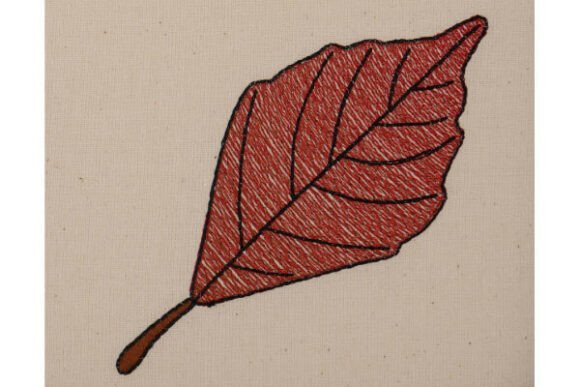
First impression? This isn’t a stiff, botanical textbook leaf—it’s a sigh of autumn air caught in thread. The Autumn Leaf – Curved Fills Embroidery leans into organic flow rather than rigid symmetry. Its curves aren’t forced; they swell and taper like real foliage catching light. There’s no sharp vein work or dense satin borders—just gentle, directional fill stitches that shift subtly with the leaf’s contour. That makes it feel alive, not printed. I immediately pictured it on a linen tea towel for a local café’s fall launch—soft enough for kitchen warmth, distinct enough to read at arm’s length.
Where It Shines (and Where It Asks for Thought)
I tested Autumn Leaf – Curved Fills Embroidery across three real projects: a medium-weight cotton tote bag, a French terry sweatshirt, and a 100% cotton baby blanket. On the tote? Perfect. The curved fills translated beautifully—no puckering, no thread breakage. Customers paused mid-browse to trace the shape with their fingers. On the sweatshirt? Slightly trickier. The fabric’s nap softened the edge definition just enough that I swapped to a lighter-weight stabilizer and added one extra underlay pass—small tweaks, but worth noting if you’re stitching for a craft fair booth where first impressions matter.
The baby blanket was the real litmus test. Fine cotton, delicate handling, and zero room for stiffness. Here, the design’s low-to-moderate stitch density worked in its favor—no crunchy patches, no stiffness around the stem. Parents responded to how “light” it felt—not just visually, but physically. That’s rare in machine embroidery designs meant for infant wear.
Smart Pairings for Your Craft Business
- Tote bags & aprons: The scale and drape-friendly texture make Autumn Leaf – Curved Fills Embroidery ideal for front-panel placement—no need to crowd it with text or other motifs.
- Sweatshirts & lounge wear: Works best centered or slightly off-center on the chest. Avoid shoulder seams or curved yokes unless you’ve pre-tested hoop rotation.
- Patches & iron-ons: Clean outer edge and open interior mean it presses well—but confirm your backing holds up to heat before batch production.
- Kitchen towels & napkins: Linen and cotton blends let the curved fills breathe. Skip heavy stabilizer here; tear-away works fine.
- Etsy listings & digital product previews: Renders cleanly in printable mockups—even grayscale versions retain dimension thanks to the fill direction.
Use With Care: Real Fabric & Function Limits
This isn’t a one-size-fits-all file. Its elegance comes with quiet constraints:
- Small hoop sizes (under 4"): The leaf’s natural proportions need breathing room. Don’t force it into a 3" circle—it’ll lose its flow and risk over-stitching in tight curves.
- Stretchy or thin fabrics (like rayon challis or lightweight knits): The curved fills rely on stable tension. Add cutaway stabilizer and reduce top thread tension by 1–2 notches.
- Dark or textured fabrics: The subtle gradation in fill direction reads less clearly on heather grey or bouclé. Test thread color contrast—cream or oatmeal thread often lifts better than stark white on charcoal.
- Curved surfaces (caps, hats, mugs): Not recommended without digitizing adjustments. The curves assume flat fabric geometry.
- Frequent-wash items (baby onesies, dish towels): Confirm your thread brand’s washfastness—and always trim jump stitches close. One stray tail snagged on a toddler’s fingernail during testing (easily fixed, but worth flagging).
What It Adds to Your Finished Product—Beyond Pretty
Customers don’t buy leaves. They buy feeling—cozy, grounded, intentional. That’s where Autumn Leaf – Curved Fills Embroidery quietly elevates your handmade product. It signals care in selection, not just execution. On an Etsy listing, it boosted perceived value: buyers commented on “how soft it looked,” “like it belonged there,” and “not mass-produced.” That trust transfers directly to your brand.
For small shop owners, it’s a versatile anchor design—you can pair it with minimalist monograms, seasonal phrases (“gather,” “slow fall”), or even leave it solo. No busy background needed. Its visual clarity means it photographs well in natural light, and it scales cleanly across product photos, social posts, and packaging stickers.
Designer Notes You’ll Actually Use
- Test on scrap fabric *first*—especially if using textured or dark materials.
- Check thread color contrast in both daylight and indoor lighting; what reads softly in sun may disappear under pendant lights.
- Review stitch density visually—not just numerically. Look for areas where fills converge tightly near the tip or base.
- Confirm hoop size compatibility before digitizing adjustments or batching.
- Inspect small details at 200% zoom: are stem ends clean? Do curves transition smoothly without jagged jumps?
- Test black-and-white mockups: does the shape hold weight without color crutches?
- Compare performance on light vs. dark backgrounds—some thread combos mute the curve effect on black.
- Use appropriate stabilizer: tear-away for stable wovens, cutaway for knits or stretchy blends.
- Verify licensing terms before selling finished items or bundling as part of a digital embroidery file pack.
Final Thought: A Thoughtful Tool, Not a Trend
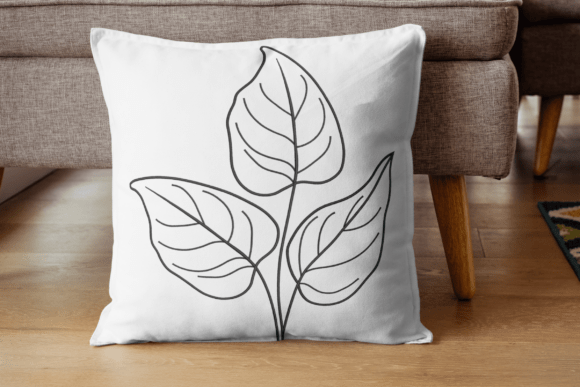
Autumn Leaf – Curved Fills Embroidery won’t shout. It doesn’t need to. Its strength is in cohesion—in how naturally it settles into a handmade pillow cover, how warmly it reads on a boutique sweatshirt, how quietly it says “fall” without cliché. For embroidery designers, Etsy sellers, and small shop owners building recognizable, repeatable style, this is less of a seasonal novelty and more of a foundational design asset. It earns its place—not because it’s flashy, but because it works, thoughtfully, across real projects and real customers.